As I walked from my car into Roosevelt Coffeehouse, I briefly wondered how I would be able to find Nancy until I noticed the only other person sporting an N95 mask. When you receive a lung transplant, you are on medication and treatment plans that significantly decrease your ability to fight off germs and viruses so it is always important to mask when out in public. We lucked out on the weather, which is unpredictable mid-Spring in central Ohio, and were able to unmask outside after grabbing our coffees.
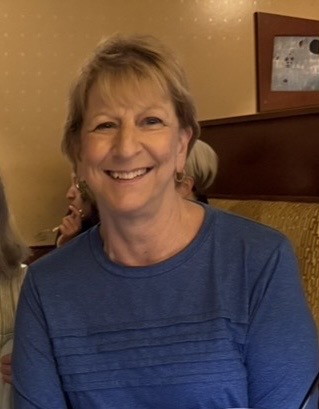
When we sat down beneath the bright orange umbrellas scattered across the gravel patio, coffee cups in hand, Nancy began telling me her story. What unfolded during our conversation was not a linear path from diagnosis to recovery. Nancy shared with me the positives and the setbacks that she faced, and is currently facing, with her single lung transplant.
For more than twenty years, Nancy worked in IT Training and Optimization at The Ohio State University Medical Center. She trained nurses across multiple departments, helping them navigate the software systems used in patient care, including transplant services. Medical practices and procedures were in her life long before she became a patient herself. And, it turns out, it is a family affair. Her daughter, Sara, was an accomplished nurse with a Doctorate in Nursing Practice. Her son, Edward, works in healthcare IT. Conversations around healthcare were normal in their family, though none of them imagined how quickly Nancy would one day become dependent on the very system she had supported professionally for decades.
For the first three and a half years of COVID, Nancy was able to avoid the virus that haunted the halls of hospitals and put the medical field team members through hell and back.
Then came a mandatory in-person team meeting in which several attendees became ill afterward. Nancy initially thought she had escaped complications, but over the following weeks, she noticed extreme exhaustion and difficulty breathing during simple daily tasks.
She cycled through appointments searching for answers. Her primary care physician prescribed antibiotics. A nurse practitioner dismissed the severity of her symptoms. An urgent care clinic sent her home with an inhaler. Nothing worked.
Eventually, a physician friend saw how sick she truly was and brought her directly to the Emergency Department (ED). There, doctors immediately administered IV steroids and oxygen. For a brief moment, it seemed to help. She returned home hoping rest would be enough.
Nancy was home for about a week and was becoming more and more short of breath. Her daughter decided she needed to go to the ED. After a long wait, a chest CT revealed that her lungs were worsening and she was admitted directly to the Intensive Care Unit (ICU). After a week, she was discharged home with oxygen. Then, less than a week later, an ambulance rushed her back to the hospital. Her oxygen saturation had dropped dangerously close to 50%. This time, she was again admitted directly to the ICU.
COVID had severely damaged her lungs. Suddenly, survival depended on high-flow oxygen and conversations about something she never imagined for herself: a lung transplant. At first, Nancy resisted the idea completely. She had spent years adjacent to transplant medicine and understood the brutal realities that can follow surgery. She had seen kidney transplant patients struggle through complications, rejection, medications, and uncertainty. Part of her hoped her remaining lung function would somehow improve enough to avoid transplant altogether. But, as the days went on, she realized that transplant would be the only treatment option for her.
While hospitalized, she began the extensive transplant evaluation process. Because inpatient evaluations move more quickly, specialists rotated endlessly through her room: pulmonologists, surgeons, coordinators, therapists, social workers. Nancy described it to me as a revolving door of white coats and conversations.
Meanwhile, her family anchored her. Her son sat in her room and outside the procedure rooms waiting for updates. Her daughter flew back and forth from California to help support and lend her expertise. Friends and relatives surrounded her with reassurance.
One procedure in particular stayed with Nancy: the cardiac catheterization. This test could not be performed in her hospital room in the ICU, so she was transported down to the cath lab. The problem? High flow oxygen cannot be administered while transporting a patient from room to procedure area. The solution was to use multiple oxygen canisters, nasal cannulas, and an oxygen mask to deliver the high rate of oxygen until they arrived in the cath lab where they reconnected to the high flow oxygen. Eventually, because of unpredictable procedure times in a hospital, any testing that could not be completed in Nancy’s room was canceled because she was too unstable to transport.
By then, Nancy was so weak that simply turning in bed left her gasping for air. Two people had to help move her from the hospital bed into a nearby chair. Her body had reached its limit. Though she still had evaluation tests to complete, Nancy was listed for transplant.
The next morning, breakfast sat untouched beside her hospital bed, hidden beneath its plastic lid that luckily contained the smell. Dr. Kirkby, her transplant pulmonologist, walked into the room then quickly, and briefly, answered a call. Even before he finished the call, he removed the tray from her bedside and told her they had found a match. Just over twelve hours after being listed, Nancy had a donor lungs.
For a while after transplant, life seemed to open back up. About a year after transplant, doctors stopped, per protocol, her virus preventative medication which protects against Cytomegalovirus (CMV), a common virus in the body that can cause complications for those who are severely immunocompromised. For Nancy, her CMV level rose rapidly leading to a number of gastrointestinal symptoms.
Then came an even greater devastation. Nancy’s daughter, Sara, died unexpectedly.
Later that same day, Nancy’s rising CMV level caused her appendix to rupture. Nancy wanted nothing more than to board a plane and be with her family in California, but surgery and her own fragile medical condition made travel impossible. CMV levels were dangerously high. Her body, once again, refused to cooperate.
Nearly a year and a half later, she is still battling fluctuating CMV levels. Medications help temporarily then her numbers rise again. The transplant team has sent studies to Mayo Clinic searching for answers as to why her infection remains resistant to treatment.
At sixteen years old, a young person decided to check the Organ Donor box as they got their driver’s license for the first time. They even told their parents about the decision. Little did the family know that they would be faced with abiding by that checked box a few years later.
Because of that gift, Nancy can visit her grandchildren and she can plan trips with friends. This summer, Nancy hopes to make it to Topsail Island in North Carolina with friends and, of course, to southern California where her grandchildren live. Years earlier, before her transplant, she had planned a trip with friends she’s known for nearly her entire career at OSUMC, but became too sick to go. One of her friends told her before leaving, “Maybe you’ll get a lung by the time we get back.”
She did.
For Nancy, some days healing looked like progress. Other days it looked simply like endurance. Everyone’s transplant journey is unique.
As the wind swept across the patio, Nancy looked at me and said, “The only thing I can do is keep living.”
 Doubletake Foundation